Kokuho (National Treasure): Film & Novel Review + Illustration Process
(日本語版はこちら)
The film ‘KOKUHO’ (National Treasure) has become a massive sensation, becoming the first domestic Japanese film in years to surpass 20 billion yen in box office revenue (as of March 2026).
Kabuki is a traditional Japanese theatre form dating back to the 17th century, known for its stylized acting, elaborate costumes, and male actors performing female roles (onnagata).
I have to admit, I was a bit apprehensive about the three-hour runtime, but I decided to go see it anyway—making sure to book a seat on the edge, just in case!
The experience was nothing short of breathtaking.
The lead performance by Ryo Yoshizawa, portraying Kikuo, was truly magnificent. His dancing and the unique, soulful cadence of his voice were simply stunning.
The entire cast felt perfectly cast—from Ryusei Yokohama, who played Kikuo’s friend and rival Shunsuke, to Ken Watanabe, who portrayed his father Hanjiro.
It truly reminded me of the incredible power that professional actors possess.
They were all phenomenal!
Film vs. Original Novel
The film is based on the novel by Shuichi Yoshida, which prompted me to read the original work. While the film is an epic three-hour journey, reading both volumes of the novel revealed just how much the story had to be distilled for the screen. Rather than simply connecting individual episodes, the film reimagines the narrative structure significantly.
(Warning: Spoilers ahead!)
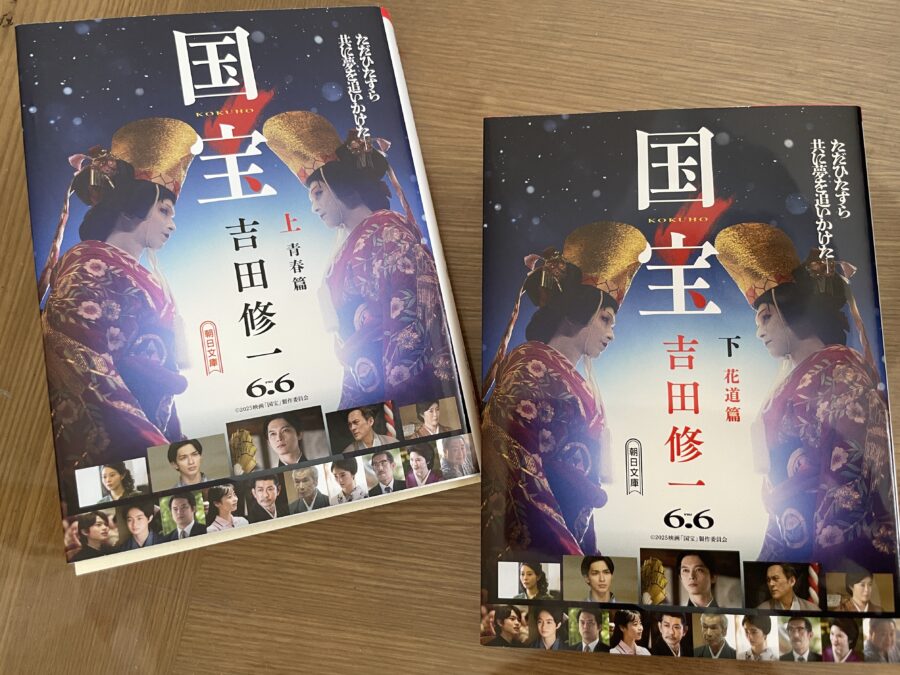
For instance, the boy Kikuo dances with during their childhood—a scene that seems brief in the film—is actually a pivotal figure in the novel who supports Kikuo personally and professionally over many years. Similarly, the role of Masa, Hanjiro’s wife, is deepened; she is not Kikuo’s biological mother, yet she remains a steadfast pillar of support throughout his career.
While the film distills the theme into a sharp “Talent vs. Bloodline” conflict, the novel beautifully illustrates that Kikuo’s talent could only bloom because he was nurtured by so many dedicated people.
At the same time, the novel portrays a much harsher reality for Kikuo, suggesting that only his extraordinary dedication to his art allowed him to survive.
The character of Shunsuke also gains much more depth in the novel. In the film, he disappears in an elopement-like fashion, only to return and claim his glory after Hanjiro’s death. However, in the book, his time away is a true descent into hell; he endures unimaginable suffering, which ultimately leads to his personal growth.
The fates of Kikuo and Shunsuke rise and fall like a seesaw. Ultimately, I felt the story isn’t just about “Talent versus Bloodline,” but rather a profound exploration of what it truly means to be a human being possessed by the arts.
Capturing the ‘Sagi Musume’ (Heron Maiden)
When I decided I wanted to draw something inspired by ‘KOKUHO,’
the scene that stayed with me the most was the final dance performed by Kikuo: ‘Sagi Musume’ (The Heron Maiden).
I was struck by the image of a white heron dancing against a deep blue background, and I used that as the foundation for my composition.
I began by saturating the watercolor paper with plenty of water, allowing shades of blue to bleed and flow across the surface.
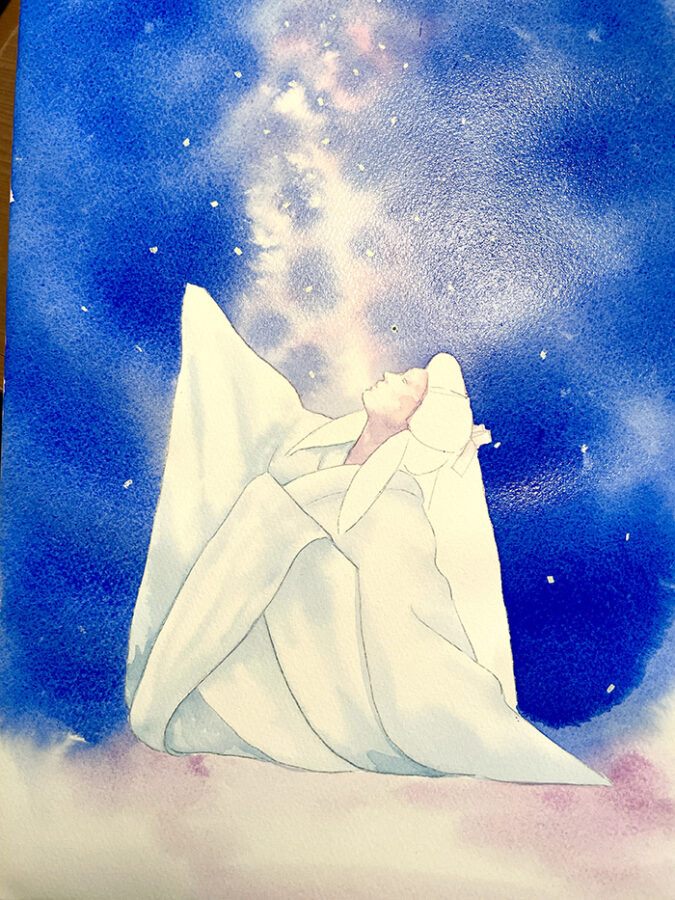
However, I didn’t want a simple “pretty blue”—I was looking for a “deep blue,” so I layered darker tones to capture the right mood.
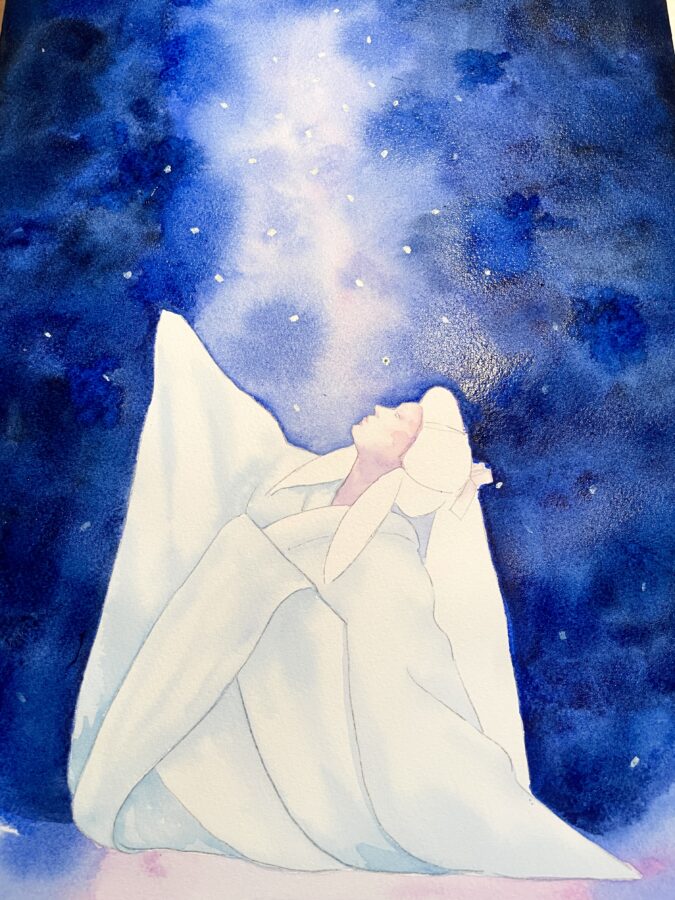
After adding the fine details, I refined the shadows digitally to bring out the depth of the scene.
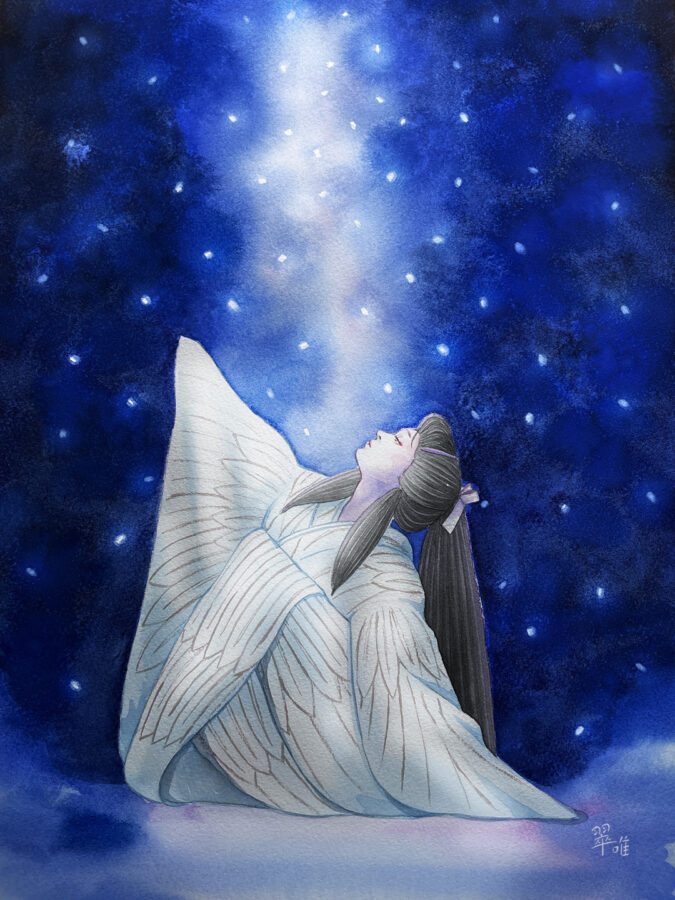
With this piece, I wanted to capture the world that can only be seen by someone who has pursued the “ultimate art” in solitude. Since the film only shows a specific moment from this performance, I also drew inspiration from the actual Kabuki play ‘Sagi Musume’ to ground the piece in tradition.
In the novel, there is a later episode where Kikuo and Shunsuke perform ‘Hikaru Genji’ together. It is a scene I dream of illustrating one day.
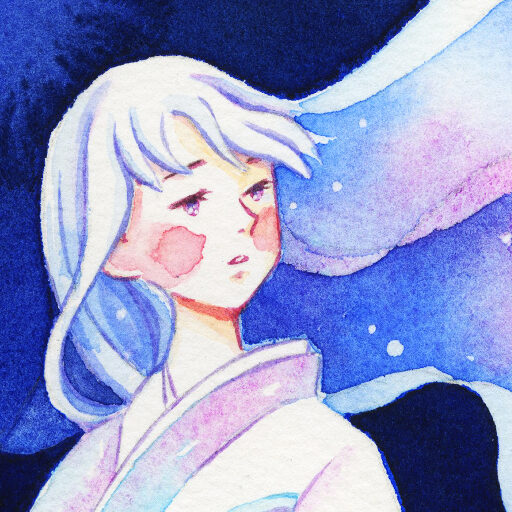
About the Artist: Sui (翠唯)
I am a Japanese illustrator based in Japan.
My work focuses on capturing the ethereal and fantastical beauty of Japanese traditions, aesthetics, and culinary culture.
For professional inquiries, please feel free to contact me via the “MAIL” link.
イラストレーター翠唯(すい)
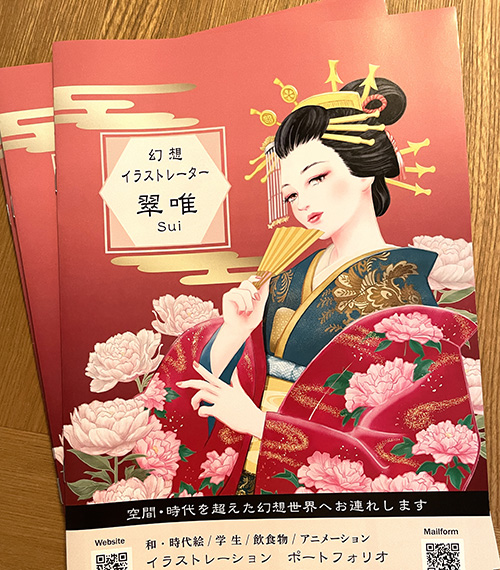
退職後、充電期間を経てフリーのイラストレーターとして活動中。
シズル感のある飲食物や、きらめき感のある情景を描きます。
企業PRイラスト、書籍や雑誌の挿絵・装画制作、教科書挿絵など実績多数あり。
得意モチーフ:飲食物、着物、制服
イラスト制作に関するご相談・ご依頼や、ポートフォリオご希望の方は、お気軽にお問い合わせください。